Weekly (Issue 5): October Blankings Hit 11% as 50% Canada Tariffs Land
This week: Carriers have already pulled 11% of sailings from the September 14 – October 18 window as Golden Week approaches, while Washington widened its 50% Section 338 tariffs on Canada on September 15 and CBP prepares to switch low-value parcel clearance to fully electronic entry on September 22. On the supply side, UBTECH's new Liuzhou plant is producing one humanoid every ten minutes, and three desktop five-axis CNC machines each cleared US$1M on Kickstarter.
Trade Policy & Tariffs
Washington widens 50% Section 338 tariffs on Canada — import bans follow on September 29
The United States expanded its 50% Section 338 duties on Canadian goods effective September 15, and will bar selected alcohol, dairy-related and motor-vehicle imports from September 29. Canada's own counter-tariffs — 15%, 25% and 50% across roughly 700 to 900 tariff lines covering about C$27.6 billion of US goods — took effect September 8, with steel and aluminium duties doubling to 50%. For buyers with North American dual sourcing, both directions of the border now carry materially different landed costs, and the exemption logic has to be rebuilt line by line rather than assumed from last quarter's model.
- CBP opens the Entry Type 13 electronic filing test for parcels up to US$2,500 on September 22
From September 22, US Customs and Border Protection begins testing Entry Type 13 (ET 13) for eligible international mail shipments valued at US$2,500 or less, moving shipment-level data — importer of record, origin, 10-digit tariff classification, value, duty rate and duty owed — electronically through the ACE system. Only importers holding an IOR status with a continuous import bond, or licensed brokers, may file; duties are paid monthly through Pay.gov. A second phase on October 22 is expected to push PGA-regulated categories out of the simplified channel. Sellers who built low-value direct-to-consumer models on simplified postal clearance should confirm which entity actually holds filing rights before Q4 volumes ship.
- From September 18, CBP can revoke an importer's entry privileges over inaccurate customs information
Beginning September 18, CBP may revoke an importer's ability to bring goods into the United States if its customs information is inaccurate — a rule that applies to every importer of record, including those filing through a customs broker. In parallel, CBP's Advance Notice of Proposed Rulemaking on heightened import disclosures asks whether importers should retain or submit foreign export documentation, name supply-chain parties more precisely, and adopt global business identifiers and tracing technology; comments close December 1, 2026. Supplier master-data governance, document retention and broker collaboration are shifting from back-office hygiene to a condition of market access.
Supply Chain & Logistics
- Drewry's World Container Index holds flat at US$4,476 — transpacific up, Asia–Europe down
The September 10 assessment put the composite at US$4,476 per 40ft, US$11 above the September 3 reading and flat for a second consecutive week. Underneath, Shanghai–Los Angeles rose 2% to US$7,352 and Shanghai–New York 1% to US$9,726, while Shanghai–Rotterdam fell 2% to US$3,997 and Shanghai–Genoa 3% to US$4,216. The Mediterranean premium over North Europe narrowed to US$219, down from US$276 a week earlier. Rotterdam–New York, meanwhile, climbed 3% to US$3,126 — 100% higher than at the outbreak of the US–Iran conflict.
- Golden Week blank sailings jump to 11% — 79 of 721 sailings cancelled between September 14 and October 18
Announced blanks on the same four-week window went from 39 to 70 in a single week. Drewry's September 11 tracker counts 79 cancellations against 721 planned sailings, an 11% rate, versus 47 of 729 (6%) a week earlier; transpacific eastbound accounts for 52% of cancellations, Asia–Europe 33% and the transatlantic 15%. CMA CGM has added a peak season surcharge from October 1 of US$4,000 per 40ft from the Far East and Indian subcontinent to the US West Coast, and US$10,000 per 40ft from the Indian subcontinent to the US East Coast. If your early-October cargo is booked on a blanked string, expect a roll — and a longer wait for the next available departure.
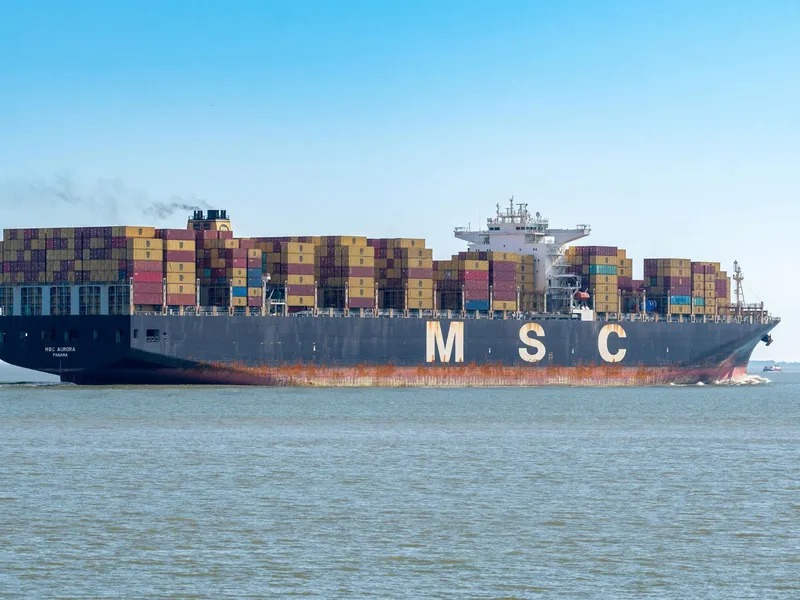
- Shanghai and Ningbo berth waits stretch to 12 days as September shapes up to be the busiest US import month of 2026
Four typhoons in seven weeks have left export cargo backed up in China, with Linerlytica reporting vessels waiting up to 12 days for a berth in Shanghai and Ningbo. Clearing that backlog through the Golden Week window matters, and consignees in Europe and North America should expect bunched vessel arrivals through October. The NRF now expects September to be the busiest US import month of 2026 at 2.31 million TEU, while Asia–Europe schedule reliability has fallen to 10% and Asia–North America to 23%. The Port of Los Angeles closed its busiest three-month period on record with more than 2.9 million TEU handled from June through August.
Factory & Manufacturing
- UBTECH commissions a 10,000-unit humanoid factory in Liuzhou — one robot every 10 minutes
UBTECH began operations at its industrial humanoid robot super factory in Liuzhou, Guangxi on September 12. The 14,000 sq m plant is designed for annual capacity above 10,000 units at a takt of roughly one industrial humanoid every 10 minutes, running the Walker S and Cruzr platforms on a flexible mixed line. Each finished robot takes more than 2,000 screws across some 50 specifications, with torque telemetry logged against a serial number, and the floor is worked by Cruzr mobile manipulators, AGVs and unmanned forklifts — robots building robots. UBTECH built the site with Siemens Digital Industries Software, validating the 10-minute takt in a 1:1 Plant Simulation digital twin before committing capital, and says its supply chain is more than 90% localised in China. Full-size humanoid revenue rose 1,445% in the first half of 2026 on 921 bipedal deliveries, and the company is targeting a unit production cost below US$20,000 by 2030. For component buyers, the ramp is a demand signal for reducers, ball screws, torque sensors and vision modules — and a reminder that Chinese supply-chain depth remains the cost benchmark in this category.

- Welgao breaks ground on Thailand Phase II, adding 1.2M sq m of high-end PCB capacity
Jiangxi Welgao Electronics broke ground on September 9 for Phase II of its Thai plant, WELL TEK, which will add 1.2 million square metres of annual capacity for high-layer-count and HDI PCBs — the class used in AI server power systems. Phase I in Thailand is already running, the Jiangxi Phase II project reached stable production in 2026, and Jiangxi Phase III is scheduled for the second half of 2027, with the company targeting RMB 10 billion in annual output value by 2030. For buyers of server, networking and power hardware, the shift of high-end PCB capacity into Southeast Asia is a slow but real improvement in both lead time and tariff exposure.
- ArcelorMittal and China Oriental unveil AMORNEX — a 1.8Mt/yr electrical steel base in Changzhou
ArcelorMittal Jinxi New Materials unveiled its AMORNEX brand on September 9 for a Changzhou joint venture planned at 1.8 million tonnes of annual electrical steel capacity, with a first phase of 500,000 tonnes of high-performance non-oriented electrical steel. The main structure is complete and the project has shifted from construction to equipment installation, with the CTCM six-high tandem cold rolling mill base plate in place and mill stands due for completion by end-September; production is targeted for mid-2027. Output is aimed at drive motors for new energy vehicles, high-efficiency industrial motors, servo motors for robots and advanced air mobility — categories where motor-grade steel availability has been a quiet constraint on both cost and delivery.
New Products & Sourcing Ideas
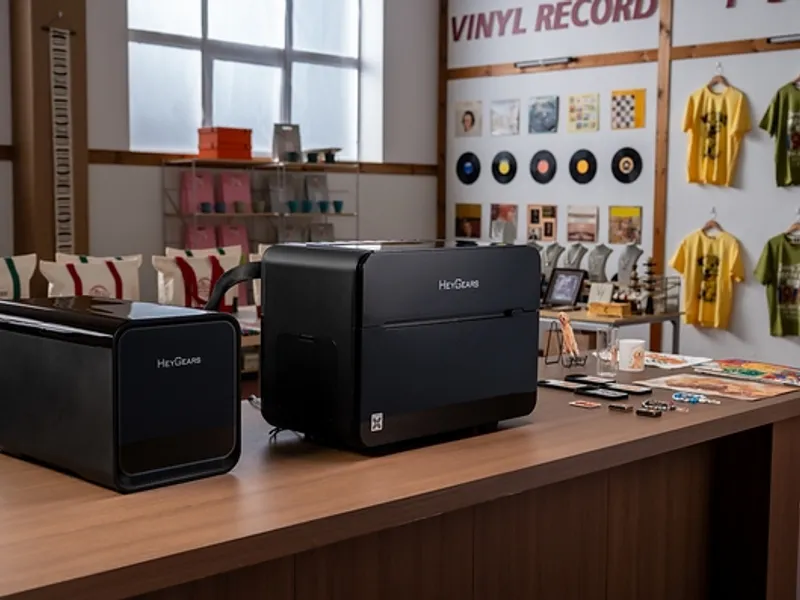
- HeyGears G1X Series — desktop full-color 3D and UV printing closes Kickstarter at US$15.4M
HeyGears closed its G1X Series campaign on September 11 at roughly US$15.4 million from more than 3,500 backers, more than half of them in the United States, against an original US$100,000 goal. The machine pairs full-color 3D printing with UV and raised-texture printing, using an Epson I3200-U1HD printhead, a 420 × 330 × 130 mm build volume, up to 1,440 × 2,400 DPI and more than 400 compatible materials. Watch the tier logic: the US$3,299 Starter Pack does not include everything needed for full-color 3D — the US$3,599 Full-3D Pack is the real entry point. First rewards ship in December 2026. For small studios producing figurines, custom merchandise or packaging prototypes, the appeal is bringing an outsourced step in-house; the caveat is proprietary resin pouches, which keep consumable costs above open-bottle alternatives.
- Three desktop five-axis CNC machines each clear US$1M on Kickstarter — and one is institution-only
InfiMaker's K1 stood at US$4,296,911 from 759 backers on September 15, roughly 86x its goal, with super early bird pricing at US$5,999 against a US$9,399 MSRP and shipping planned for December 2026. IFMAKER's M5 closed on September 13 at US$1,038,908 from 202 backers (about 21x), built around a 135 kg cast-iron frame and a 2.2 kW, 60,000 RPM spindle. Xhorse3D's Xmachine WM-100 reached about US$2.77 million, but is classified as a controlled item under NSG export rules: only companies, factories, research institutions, universities and government bodies may back it, with end-user documentation required. That last detail is the sourcing lesson — for dual-use desktop manufacturing equipment, export-control eligibility now screens buyers out before price or specification ever matters.
- QIVIKA Smart Scope — 24x phone-mounted optics with AR sky guidance, live on Kickstarter from September 15
QIVIKA launched its Smart Scope on Kickstarter on September 15 following its debut at IFA 2026 in Berlin. The roughly 300 g device delivers up to 24x optical magnification and a 3,000 mm equivalent focal length through ED glass and multi-coated optics — real optical path, not software zoom — and works handheld or on a tripod. The companion app adds AR sky guidance, identification for more than 10,000 bird species, personal observation logs and community discovery. Outdoor optics attached to the phone ecosystem remain a steady niche with genuine accessory and consumable attach rates, which is what makes it interesting as a category rather than a one-off gadget.

Sourcing Platforms & Tools
- FedEx Global Trade Navigator — duty and classification data moved upstream into the shipping flow
FedEx introduced Global Trade Navigator on September 9, a suite that pushes trade information earlier into the shipping process. FedEx Trade Planner is free and does not require a login: it looks up Harmonized System codes, estimates duties, taxes and fees, and flags recommended documentation before a label is created. Ship Manager now surfaces HS classification, customs value and country-of-manufacture review, a Shopify app displays a duty and tax guarantee at checkout, and Global Trade APIs let businesses embed classification, duty estimates and regulatory data into existing workflows. The scale of the problem is in FedEx's own 2026 Small Business Trade Index: 68% of SMBs regularly see customers surprised by duties at delivery, and 60% report lost revenue through refunds or abandoned purchases. If your checkout still shows a landed cost that stops at the border, that gap is now a measurable conversion cost.

- Willog Vision — one data set for cargo recording, response, compliance evidence and insurance
Willog launched Willog Vision on September 17, unifying four modules that logistics teams normally buy separately: Willog Safe records temperature, shock and location at one-minute intervals without USB logger retrieval; Control Tower alerts the responsible party and logs the response history across warehouse, sea and vehicle status; Intelligence generates GDP, GMP, KGSP and HACCP compliance reports automatically within three minutes with tamper verification; and Insurance writes data-based plans with automated claims covering disposal and re-shipment. Audit reporting that took 30 minutes per report by hand is the clearest cost line here. The platform rolls out in phases, with new customers able to request a PoC.
Industry Trends
- India's US$6 billion laptop market heads for its worst festive season in eight years
IDC data reported by Mint points to a 5% decline in India's overall laptop market in the September quarter, with consumer sales falling at a double-digit rate as memory costs reset prices. RAM and SSD now account for as much as 50% of a laptop's bill of materials, up from roughly 12% earlier in the cycle, and prices have already climbed about 50%: an entry-level machine that sold for ₹30,000 now sells for ₹50,000, and a mid-range ₹50,000 model now sells for ₹80,000. Retail chain Vijay Sales expects brands to raise prices another 15–20% through mid-2027 in multiple tranches. The festive quarter normally delivers more than a third of India's annual electronics sales — which makes this the clearest read yet on how far memory inflation still has to run through finished-goods pricing.

- India's smartphone OEMs lift seasonal retail hiring 34% for the 2026 festive season
Major OEMs are raising seasonal hiring by 34% year on year for the 2026 festive period, according to ETTelecom reporting data from TeamLease, Quess Corp and Randstad India, with wages up 12–15% and hiring cycles starting four to six weeks earlier than historical norms. The roles have changed too: staffing firms describe demand for people who can explain on-device AI, satellite connectivity and 5G-Advanced features, and walk buyers through device financing and buyback schemes, with the push concentrated in multi-brand outlets and large-format retail. When average selling prices rise this fast, assisted selling becomes the channel strategy — and financing partners become part of the product.
- Tariff stress test: private-supplier risk designations climb 108%, nearly double the public-company rate
RapidRatings modelled global supply chains assuming companies absorb half of their tariff costs. The result: high-risk and very-high-risk designations climbed 108% among private companies against 56% among public companies — and private companies make up roughly 75% of the average supply chain. Because many mid-tier suppliers are locked into customer contracts on thin margins, the cost has to come out of quality, efficiency or delivery rather than price. Supplier financial-health screening is moving from a procurement nice-to-have to a prerequisite, particularly for single-source and long-lead components.
Payments & Trade Finance
- U.S. Bank completes a live cross-border USBDC stablecoin transaction on Stellar
U.S. Bank announced on September 9 that it executed a live pilot transaction using USBDC, its proprietary dollar-backed stablecoin, moving value between its own entities in North America and Europe over the Stellar public blockchain. The pilot validated minting, payment redemption, freezing and clawback through the bank's internally developed Digital Asset Platform, and confirmed that tokenized value can move on a public ledger while staying integrated with the bank's finance, risk, compliance and operations systems. USBDC is not yet available to customers; the bank is exploring liquidity management, collateral mobility and cross-border treasury operations as next use cases. The significance for importers and exporters is the control set — a bank-issued token on a public chain that keeps freezing and recovery powers — because that is the version of 24/7 settlement regulated treasuries can actually adopt.

- Banking Circle expands OSL's stablecoin-to-fiat rails to six currencies
Banking Circle extended its collaboration with OSL Group on September 15, adding AUD, GBP, HKD, SGD and USD to an arrangement that previously covered EUR only. Through Banking Circle's BC-Now instant payment network, OSL's institutional clients can receive, convert and settle funds every day of the year from a single platform, rather than maintaining separate banking relationships in each jurisdiction — with fiat settlement, crypto conversion and liquidity management on one infrastructure layer. OSL's European subsidiary was recently authorised as a Crypto-Asset Service Provider by Austria's FMA under MiCAR. Multi-currency on/off-ramp consolidation is the practical takeaway: fewer banking relationships to manage, and a clearer compliance perimeter around each conversion.
Buyer Voices & Insights
- "I mean, this one is a little bit embarrassing, but our most significant saving is where we said to AI, okay, how can we negotiate on A, and AI's come back and, why don't you just buy from your other supplier?" — Tony Watson, Director of Procurement Corporate Services, Accord Healthcare, at Procurement LIVE in London
Watson said that single observation justified Accord Healthcare's AI investment for two years, because the team had overlooked a competitive supplier already sitting on the periphery. The lesson is unglamorous: the largest returns are often in re-examining existing relationships, not in finding new ones.
- "We've got developers who are burning US$3,000 of tokens on Claude a day. It's becoming really quite significant… AI is probably now 3% of our total cost base after real estate and cloud. It's our biggest spend area." — Roger O'Gorman, Global CPO, Checkout.com
O'Gorman described a management board now pressing the executive team on what is being spent on AI and what the tangible return is. Agentic sourcing has a cost curve of its own, and it lands in the same budget conversation as every other category.
- "While government has made a few important and welcome changes to the main tariff supports, the programs continue to exclude about half of the small business community." — Corinne Pohlmann, Executive Vice-President, Advocacy, CFIB
CFIB's September 10 estimate puts 53,112 Canadian businesses directly in scope of either US tariffs, Canadian counter-tariffs or both — 13,160 exporters and 45,414 importers. Its proposals include a dedicated Small Business Tariff Relief program with initial relief up to C$70,000, an SME desk to speed remission decisions, and a small business corporate tax rate cut from 9% to 6%. For cross-border SME buyers, the relief architecture matters as much as the tariff schedule itself.