Weekly (Issue 6): Secondary Tariff Risk Lands as Transpacific Rates Break $10K
This week: Washington signs a Russia sanctions bill that opens the door to 100% secondary tariffs on the largest buyers of Russian oil — China and India are both in scope — while the US and China quietly extend their Busan truce to January 10, 2027. Meanwhile transpacific spot rates break $10,000 to New York, September imports run at the busiest pace of 2026, and memory costs keep rewriting the holiday-season price list.
Trade Policy & Tariffs
A sanctions bill turns tariff policy into a secondary-sanctions tool
On September 18, President Trump signed the Lindsey O. Graham Sanctioning Russia and Iran Act of 2026 (H.R. 5334) into law. Section 112(a) directs the president to impose 500% tariffs on goods imported from Russia — oil, natural gas, LNG, petroleum and petrochemical products, coal and coal products — within 30 days. Section 113 goes further: it authorises duties of up to 100% on goods from the five largest importers of Russian crude oil or natural gas, and on the five countries facilitating Russian oil sanctions evasion, measured over a rolling 12-month window and reviewed every 180 days. As of August 2026, China and India both fall inside those parameters. The duties stack on top of existing HTS, Section 301 and AD/CVD measures, and the same act extends the Iran Sanctions Act of 1996 through 2031.
For importers, the practical question is no longer only "what is my China rate" but "what is my total stacked rate if Section 113 is applied." A narrow carve-out exists for countries whose Russian gas purchases were under 15% of Russia's total gas exports in the relevant period and which have taken significant steps to reduce those purchases. Everyone else in the top five should be modelling the cost today, not after the Federal Register notice.
"Currently, both India and China would fall within the parameters of section 113." — Cherry Bekaert, on the scope of the new tariff authority
- The Busan truce is extended to January 10, 2027 — two more months of tariff certainty, not a deal
Treasury Secretary Scott Bessent said on September 23 that Washington and Beijing agreed to extend the Busan Agreement, the bilateral trade truce reached at the October 2025 APEC summit, from its original November 10 expiry to January 10, 2027. The agreement keeps US tariffs on Chinese imports at 47% and commits China to restoring rare-earth supplies and purchasing 25 million tonnes of US soybeans. Bessent was candid that delivery has been uneven: China has been "very generous" on soybeans but has fallen "a little behind" on other agricultural commitments. The extension lands just ahead of a Trump–Xi summit in Washington, where tariffs, agricultural purchases, AI and financial services are on the agenda.
For sourcing teams the takeaway is narrow but useful: the current Section 301 structure is not going anywhere before Q1 2027, and rare-earth availability should hold. Plan the first half of 2027 against the existing rate card, and treat any summit announcement as upside rather than as the base case.
- The October compliance calendar: higher MPF, CAPE Phase 3 refunds, and a December 1 comment deadline
Three dates matter for importers over the next ten weeks. From October 1, the minimum Merchandise Processing Fee rises to $34.58 and the maximum to $670.86, with the 0.3464% ad valorem rate unchanged. On October 6, CBP begins Phase 3 CAPE refunds covering certain finally liquidated entries for eligible plaintiffs — importers who submitted a valid Importer of Record number to CBP by July 30 may be able to file declarations. And on December 1, comments close on CBP's Advance Notice of Proposed Rulemaking on expanded importer supply-chain data requirements.
Two other changes are already live. CBP revised the product scope of the 50% Section 338 additional duty on Canadian goods, adding 122 HTS classifications and removing others including certain alcohol products; and the October 1 fee increase lands in what the NRF/Hackett Global Port Tracker expects to be the busiest import month of 2026, with September volumes running at 2.31 million TEU.
Supply Chain & Logistics
- Transpacific rates break $10,000 to New York as carriers pull capacity into Golden Week
Drewry's World Container Index rose 1% to $4,500 per 40-foot container in its September 17 assessment, but the headline number hides a widening split. Shanghai–Los Angeles climbed 5% to $7,712 and Shanghai–New York rose 7% to $10,394 — a $668 weekly jump that makes the US East Coast the most expensive of Drewry's four headline routes. Asia–Europe moved the other way: Shanghai–Genoa fell 5% to $4,016 and Shanghai–Rotterdam dropped 9% to $3,626. It is the seventh consecutive week the two trades have moved in opposite directions.
The cause is capacity management rather than demand. Nine transpacific blank sailings are scheduled for the coming week, up from eight, while Asia–Europe cancellations rise from one to four. Shanghai waiting times lengthened from 65 hours in Week 36 to 78 hours in Week 37. For US-bound buyers, the New York premium over Los Angeles now stands at $2,682, or roughly 35% — worth re-testing your port mix if your inland destination is flexible.
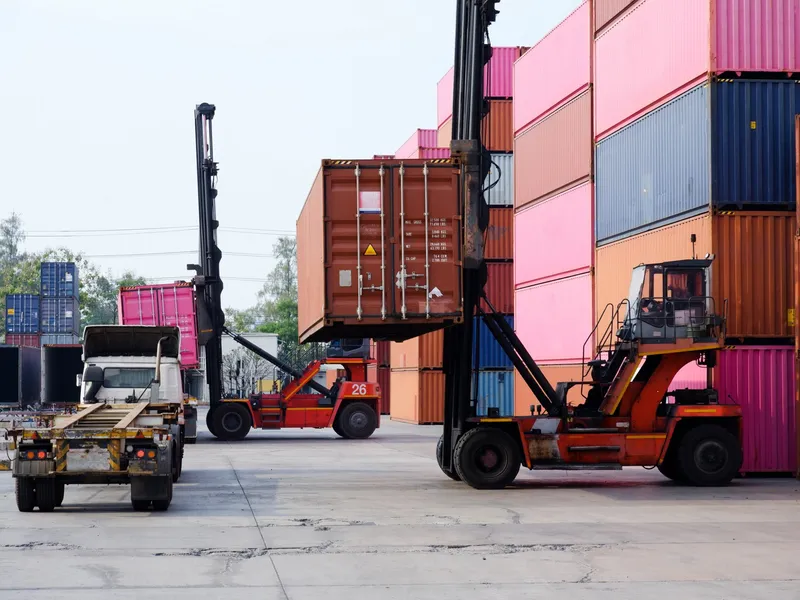
- September is now forecast to be the busiest US import month of 2026
The NRF and Hackett Associates now expect 2.31 million TEU to move through US ports in September, up 9.6% year on year and slightly above July — which would make September the single busiest import month of 2026. Full-year imports are projected at roughly 25.7 million TEU, about 1% above 2025. The later peak reflects vessel delays caused by severe weather in China and some rerouting away from the Panama Canal, rather than a demand surge.
Capacity is being withdrawn at the same time. Drewry counts 77 blank sailings across Weeks 39 to 43 out of 720 planned sailings — an 11% cancellation rate, with 55% of the cuts on the eastbound transpacific, 31% on Asia–North Europe/Mediterranean and 14% on the transatlantic. Sustained overall volume can coexist with much tighter space on individual services, so cargo-ready dates and cutoffs need checking shipment by shipment.
- Hormuz traffic collapses and German port talks stay unresolved
Commercial traffic through the Strait of Hormuz remains far below normal. Preliminary Kpler data reported by Reuters showed only two commodity vessels crossing on September 21, down from ten the previous day, against roughly 125 large commercial vessels per day before the current conflict. On September 21 a tanker on an inbound transit was struck by an unknown projectile, with two crew members sustaining minor injuries. Carrier advisories continue to include booking restrictions and routing changes for certain cargo types and Gulf destinations.
In Europe, labour talks at Germany's major seaports remain unresolved after members rejected the latest employer offer, which included a 3.4% wage increase retroactive to August 1 plus €200 in holiday pay. A member survey found 64.7% in favour of rejection; the union is running a formal ballot through the evening of October 1, and at least 75% of participating members must support rejection before indefinite strikes can be considered. No strike has been called.
Factory & Manufacturing
- Some of the production that left China is quietly coming back
Reuters reported on September 14 that buyers who moved sourcing out of China to escape tariffs are restoring Chinese suppliers after hitting supply gaps, equipment shortages and unstable power abroad. US retailer Target has moved some orders back to Chinese suppliers, according to two people familiar with the matter, citing supply-chain disruptions and production constraints at alternative sites; the value and duration were not disclosed. Shein is scaling back operations in Vietnam, where a warehouse and logistics centre that once covered 15 hectares is now down to about 6 hectares.
The tariff arithmetic that justified the move has also narrowed. Economist Intelligence Unit estimates from July 2026 put the effective US tariff rate on Chinese goods at roughly 20%, against 6.1% for Vietnam, 13.4% for Indonesia and 4.5% for Thailand — a spread too thin to absorb the cost of duplicating a supply chain. For buyers, the relevant lesson is not that China is cheap but that the full landed cost of a second sourcing base is usually under-modelled at the approval stage.

- China's August industrial output accelerates on robots and batteries
China's value-added industrial output rose 5.2% year on year in August, up 0.7 percentage points from July and ahead of the 4.8% consensus. Manufacturing grew 6.1%, equipment manufacturing 12.1% and high-tech manufacturing 16.7%. At product level, industrial robot output jumped 34.6%, lithium-ion battery output 57.2% and 3D printing equipment 29.9%. New growth drivers contributed more than 60% of the increase in industrial output, according to the National Bureau of Statistics.
The picture is more mixed on the demand side. August exports rose 25.0% in US dollar terms, but retail sales grew only 0.4% and fixed-asset investment for January–August fell 7.2%, the sharpest decline since April 2020. The manufacturing PMI came in at 49.8, still in contraction territory, even as the production expectations index held at 53.8. For sourcing managers this supports the working assumption of firm supply-side capacity and softer domestic demand — good for negotiating availability, less informative about where end-market growth will come from.
New Products & Sourcing Ideas
- kubi 2.0 — a desktop telepresence robot that gives AI agents a physical presence
iPresence launched kubi 2.0 on Kickstarter on September 18. The Kobe-based company licensed manufacturing and sales rights from the original US maker, Xandex, and rebuilt the mechanism, electronics and production method around ten years of user feedback. The new unit adds a magnetic tablet mount, a lower centre of gravity, improved quietness and USB-C power, and offers up to 300° of horizontal rotation with 55° of vertical movement, controlled from a phone, tablet or PC.
The pitch has two sides. For telepresence, it is aimed at education and healthcare — letting a child in a hospital room turn to face the teacher during a lesson. For "Physical AI," it is positioned as a body for AI agents, with a face-tracking application planned and an API for external AI agent developers. A donation tier lets backers send units directly to a school or hospital.

- CyboPal ONE — the first "desktop robotic terminal," launching September 22
CyboPal opened its Kickstarter campaign for CyboPal ONE on September 22, after collecting more than 6,000 followers and taking $30 pre-launch deposits. The device pairs a display with a robotic arm and voice and gesture control, so the screen can be called closer when you lean back, reoriented between landscape and portrait, and repositioned for different working postures. Voice commands can also drive AI agents and computer tasks without a keyboard and mouse.
The Hong Kong-based company showed the hardware at CES 2026 and demonstrated it at IFA 2026. For hardware buyers, the interesting part is product category rather than component: it is an attempt to make the physical desktop adapt to the user, rather than the other way around, in the same wave of "agentic hardware" that produced several funded campaigns this quarter.

- MAKERphone 2.0 — a build-it-yourself 4G phone that dropped the soldering iron
CircuitMess launched MAKERphone 2.0 on Kickstarter on September 10 with a $30,000 goal, which was met in the first 49 minutes and cleared five times over within a day. The campaign has raised $272,928 from 1,563 backers as of September 24, per GizmoCrowd, with roughly 25 days left to run. The kit starts at $129 against a $169 post-campaign price.
The headline change from the 2018 original — which raised over $324,000 from 2,154 backers as "Ringo" and required about seven hours of soldering — is that every component now clicks, screws or plugs into place, bringing assembly down to roughly two hours. Inside is an ESP32-S3 with 4MB flash and 4MB PSRAM, 4G LTE Cat-1 with 2G fallback, a 1.77-inch colour display, a 1,000mAh battery and a microSD slot. Six snap-on UMAX modules are auto-detected on connection, and the VibeBoy studio turns plain-English descriptions into running code across four skill tiers. Fulfilment is estimated for mid-2027.

Sourcing Platforms & Tools
- Beroe launches abi, a conversation-first procurement analyst
Beroe released Beroe abi on September 23, a full rebuild of its Live.ai market intelligence platform as an agentic, chat-based analyst. Users ask sourcing questions in natural language and receive a single synthesised answer drawn across six intelligence domains: category, supplier, commodity, cost structure, macro and risk. Where Beroe has coverage it answers from its own validated intelligence; where it does not, users can run a web search through what the company calls a procurement lens, with sources and methodology left visible either way.
The underlying data set is the differentiator: more than 30 million validated data points generated from over a billion raw signals, 425+ licensed subscriptions and data partners, a 25,000+ supplier network, and input from 10,000 procurement professionals. Where a decision needs human validation, abi routes to Beroe's VOX expert network — 400+ analysts and category specialists, with a broader VOX community now at 5,000.

- Zip extends AI Risk Orchestration into full third-party risk management
At its Zip Forward conference on September 16, Zip expanded AI Risk Orchestration — introduced in April 2025 — into a complete third-party risk management solution that sits inside the purchasing workflow. The platform triages incoming requests, decides when an assessment is needed, pre-fills questionnaires from supplier data already in Zip, scores suppliers against the customer's own methodology and tracks each finding to resolution before a purchase is approved. Reassessments run on policy-defined cadences with continuous monitoring.
Zip also launched a Sourcing Superagent and a PO Management Superagent, an AI data-partner ecosystem starting with price benchmarking, a self-service app marketplace and accrual automation. The company reports that since launch, AI Risk Orchestration customers have achieved 85% faster cycle times, 98% portal completion rates and 2x supplier risk coverage, while cutting manual review work by up to 90%.
Industry Trends
- The memory crunch is rewriting the holiday electronics price list
Memory has moved from commodity to constraint, and the 2026 holiday season is where buyers will feel it. DDR4 prices have risen sharply as suppliers shifted capacity toward DDR5 and HBM, while NAND pricing rebounded after industry-wide production cuts. Apple has already raised prices substantially on notebooks and tablets and is reported to be delaying the iPhone 18 to 2027 with further increases of 10–20%. For some products, memory cost is approaching or exceeding the rest of the bill of materials.
Manufacturers are responding by changing how they buy, not just who they buy from: longer-term partnerships with distributors, memory specialists and technology providers are replacing spot purchasing, and predictability is being valued alongside price. There is also renewed interest in older memory generations — precisely as major suppliers withdraw capacity from them, creating a structural gap that cannot be closed quickly. The practical read for procurement is that supply security and qualification of alternative sources are becoming competitive advantages in their own right.

- Korean DRAM export unit price is up 401% year on year
The scale of the memory squeeze shows up clearly in trade data. South Korea's Trade Statistics Promotion Institute reported that the DRAM export unit price for August 1–20 reached $92,183 per kilogram, up 401% from a year earlier and 12.5 times the January 2023 trough of roughly $7,400 — one kilogram of DRAM was worth the equivalent of 620 grams of gold. DRAMeXchange quoted 16Gb DDR5 eTT chips at an average spot price of $24.80 on September 21, or $1.55 per gigabit.
Forecasters see no quick relief. TrendForce expects HBM to absorb 30% of the top three suppliers' DRAM wafer input by the end of 2027, while Goldman Sachs forecasts the DRAM supply deficit widening from 5.0% in 2026 to 5.9% in 2027. The shortage has now spread to DDR2, pushing brand manufacturers and ODMs to downgrade specifications on some products and switch to older-generation memory — a move that raises DDR2 demand further, with third-quarter contract prices expected to rise another 35–40%.
- India's festive smartphone volumes are heading for a 10% decline
India's smartphone market is expected to sell 10% fewer units this festive season than last year, according to Counterpoint, after a Q2 2026 that was already down 11% year on year. The global market contracted 7.4% to 276.3 million units in Q2, its second consecutive quarterly decline, with memory shortage adding to cost and supply pressure. Memory costs are running nearly 300% higher year on year, and TrendForce expects conventional DRAM contract prices to rise a further 13–18% in Q3, following a 93–98% increase in Q1.
Brands have already passed costs through: Realme raised prices by ₹1,000–4,000 across several models, Oppo by up to ₹5,000 on selected Reno and A-series phones, Vivo by ₹500–4,000, and OnePlus by ₹2,000–4,000, with one Galaxy S25 variant now ₹12,000 more expensive. With discounts harder to fund, the industry is pivoting to financing — roughly 42% of transactions are expected to run through credit-card EMIs, debit-card instalments and NBFC loans, with offline retail favoured for its underwriting reach.
Payments & Trade Finance
- Circle buys Tazapay for $400 million — and what it is really buying is the licence stack
Circle agreed on September 8 to acquire Singapore-based cross-border payments firm Tazapay in an all-stock deal valued at roughly $400 million. It is Circle's largest acquisition since Poloniex in 2018 and its first major deal since its June 2025 NYSE listing. Tazapay processes more than $25 billion in annualised payment volume — up from over $10 billion in August 2025 — across local payout rails in more than 100 markets and relationships with over 60 banking and fintech partners. As of July 31, roughly 60% of its transaction volume already involved stablecoins.
The most commercially significant asset, though, is regulatory rather than transactional: Tazapay holds a Major Payment Institution licence from the Monetary Authority of Singapore covering domestic and cross-border money transfer, alongside a FINTRAC registration in Canada, an AUSTRAC registration in Australia, a FinCEN registration in the United States, and money transmitter permissions in India and Hong Kong. Closing is conditional on MAS approval under its change-of-control assessment. For exporters and marketplaces, the near-term signal is that regulated bank connectivity — not token issuance — is the scarce part of stablecoin settlement, and that licensed banks are increasingly taking that connectivity role.

- Stablecoin settlement volume hits $1.2 trillion in 30 days as supply stays concentrated
Adjusted stablecoin transaction volume totalled $1.2 trillion over the latest 30 days, underscoring how much cross-border and treasury flow now runs on tokenised dollars even as the broader crypto market weakened. Supply remains highly concentrated: Tether controls about 60% of stablecoin supply and Circle about 24%, a structure that raises the risk of banks losing deposits and payment revenue to non-bank issuers.
Institutional entry continues regardless. On September 1, 21 financial institutions including Bank of America, Citi, Goldman Sachs and Deutsche Bank said they plan to jointly issue a US-dollar-backed stablecoin in the first half of 2027, targeting a new company by the end of 2026 with euro and other G7-currency tokens to follow. MVB and Velocity have also joined a Visa Direct stablecoin-settlement pilot. The regulatory frameworks — the US GENIUS Act and the EU's MiCA — have made fiat-backed tokens easier for institutions to evaluate, though redemption runs and the absence of deposit insurance remain unresolved concerns.
Buyer Voices & Insights
- "The backlash on the market side is actually what's affecting us the most." — Mateo Kehler, co-founder, Jasper Hill Farm
Kehler's Vermont creamery lost Canadian wholesale customers almost immediately after the US–Canada dispute escalated, even though cheese was not on the initial US tariff list. He also reported suppliers adding surcharges tied to rising energy costs. It is a reminder that in a tariff dispute the demand-side reaction can arrive faster than the duty itself — and that it lands on suppliers who were never named in the measure.
- "When we last had this conversation on 30 July, we had every reason to believe that we were past the peak." — Barış Aytan, director of client success and commercial operations, CargoTrans
Speaking on the persistence of September volumes, Aytan argued that structural capacity limits — not demand alone — are now the dominant pricing driver, adding that carriers are cautiously resuming Red Sea transits because "there is an appetite for risk right now," without any improvement in the underlying security picture. Buyers planning Q4 should read the current rate level as capacity-driven and therefore reversible only slowly.
- "Risk management has traditionally lived beside procurement, even though the purchasing process is where companies decide which vendors they're willing to trust." — Rujul Zaparde, co-founder and CEO, Zip
The same cross-border squeeze is hitting capital equipment buyers. Darcy Lane, co-founder of Vancouver Island-based Revival Stillworks, said distilling equipment that previously crossed into the US duty-free under USMCA now faces tariffs of up to 50% — a material number when individual stills and fermenters cost between $250,000 and $2 million. For anyone sourcing high-value equipment across a tariff wall, the binding constraint is often the working-capital hit at the border, not the unit price.